Devon & Cornwall
Heat Pump Running Costs Explained
A straightforward look at what it actually costs to run an air source heat pump, what pushes the bill up or down, and how to set realistic expectations for a home in the South West.
Figures reviewed: August 2026 · Planning bands from public equipment prices plus professional install layer — how our numbers are built. Not a fixed quote.
Quick Answer
For a typical three-bedroom house, annual running costs for a properly designed air source heat pump currently sit somewhere between £850 and £1,400 for heating and hot water.
Better insulated homes on a specialist heat pump tariff often come in towards the lower end. Older or less well prepared properties sit higher. There isn’t a single figure that works for every house.
View printable checklist Planning aid — not a quote
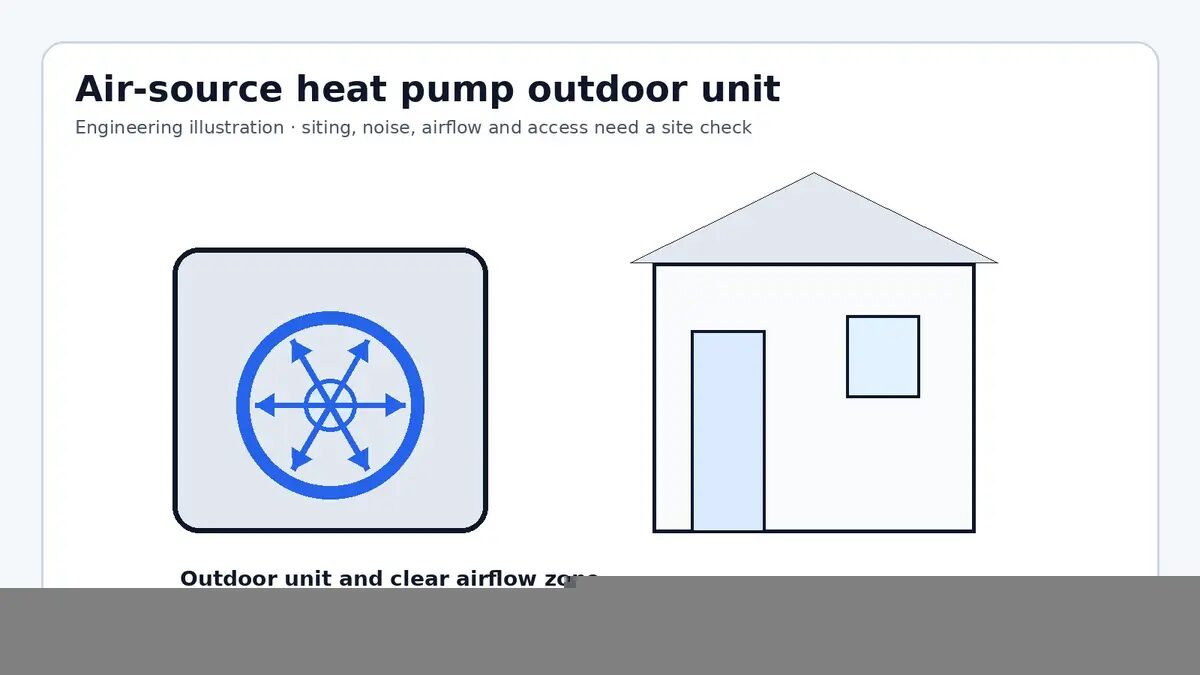
Add image: /images/heat-pump-running-costs.jpg
How the running cost is worked out
At its simplest, the calculation looks like this:
Annual heat demand ÷ SCOP × electricity unit rate = yearly running cost
Three things drive the result:
Heat demand
How much heat the house actually needs over a year. This is heavily influenced by size, insulation and how draughty the building is.
SCOP
The seasonal efficiency of the heat pump — how much heat it delivers for every unit of electricity it uses across a full year.
Unit rate
What you pay per kilowatt hour of electricity. A specialist heat pump tariff can make a noticeable difference here.
View printable checklist Planning aid — not a quote
VAT and running costs
The running cost figures on this page are based on domestic electricity unit rates. Domestic electricity already includes 5% VAT, so that is already built into the numbers.
Separately, most heat pump installations currently benefit from 0% VAT on the equipment and installation work (under current rules until March 2027). That helps the upfront cost, not the ongoing running cost.
Grants and support available
Running costs are only half the story. The upfront cost of a heat pump is currently reduced by meaningful government support.
Boiler Upgrade Scheme
This is the main grant available in England and Wales, including Devon and Cornwall. It provides £7,500 towards an air source heat pump in most cases, or £9,000 where you replace oil or LPG and the property has no mains gas connection (time-limited uplift — confirm GOV.UK).
The money is paid straight to the installer and comes off the total installation cost. It doesn’t change the running costs, but it does improve the overall numbers significantly.
ECO4 and Local Authority Flex
ECO4 was a scheme that could fully fund energy efficiency work (including heat pumps in some cases) for lower-income and fuel-poor households.
Current position in Devon and Cornwall (July 2026): ECO4 and Local Authority Flex are largely closed for new applications across most of the region. Cornwall Council stopped new applications earlier in 2026, and several Devon councils have done the same. What remains is mainly the completion of jobs that were already approved.
When the scheme was active, it typically required either certain benefits or a local authority referral (often based on household income or a relevant health condition), plus an EPC rating of D to G.
For most homeowners in the South West right now, the Boiler Upgrade Scheme is the main active grant for heat pumps. It’s best not to rely on new ECO4 funding being available.
Realistic annual cost ranges
These figures assume a properly designed system and cover both heating and hot water. They are based on current domestic electricity rates.
| Property | Typical heat demand | Annual running cost |
|---|---|---|
| 1–2 bed / flat | 6,000 – 9,000 kWh | £650 – £1,000 |
| Typical 3-bed house | 9,000 – 13,000 kWh | £850 – £1,400 |
| Larger 4-bed house | 13,000 – 18,000 kWh | £1,200 – £1,800+ |
Better tariffs and higher efficiency pull costs down. Poorer insulation and higher flow temperatures push them up.
How the cost spreads through the year
Heat pump running costs are not even across the seasons. Most of the electricity is used in the colder months.
| Period | Share of annual cost | Typical monthly cost (3-bed) |
|---|---|---|
| Winter (Dec – Feb) | 45 – 55% | £120 – £220 |
| Spring / Autumn | 30 – 35% | £60 – £110 |
| Summer (Jun – Aug) | 10 – 15% | £25 – £50 |
Summer costs are mainly hot water. Winter carries the bulk of the heating load.
How SCOP affects the bill
The same house with the same heat demand can produce quite different bills depending on the seasonal efficiency (SCOP) the system actually achieves.
Example for a typical three-bed house needing around 11,000 kWh of heat a year, at an electricity rate of 26p per kWh:
| SCOP | Electricity used | Annual cost | Difference from SCOP 3.5 |
|---|---|---|---|
| 2.8 (poor) | 3,930 kWh | £1,022 | +£205 |
| 3.2 (average) | 3,440 kWh | £894 | +£77 |
| 3.5 (good) | 3,140 kWh | £817 | Baseline |
| 3.8 (very good) | 2,895 kWh | £753 | –£64 |
A difference of around 0.7 SCOP points can easily mean £150–£250 a year on a typical house. Design quality and flow temperature are the main things that move SCOP up or down.
Heat pump versus gas boiler
Full comparison: heat pump vs gas boiler running costs.
Electricity costs more per unit than gas, so the heat pump needs good efficiency to compete. Here’s a realistic comparison for a typical three-bed house.
| System | Typical efficiency | Approx. annual cost | Notes |
|---|---|---|---|
| Modern gas boiler | 90 – 94% | £850 – £1,150 | Current gas prices |
| Heat pump (good design) | SCOP 3.3 – 3.7 | £800 – £1,150 | With a decent tariff |
| Heat pump (average design) | SCOP 2.9 – 3.2 | £950 – £1,350 | Higher flow temperatures |
| Older oil boiler | 70 – 85% | £1,400 – £2,000+ | Higher fuel cost |
In a well-prepared home a good heat pump is often similar to, or slightly cheaper than, a modern gas boiler. In average or poorly prepared homes the difference can go either way.
How much difference insulation makes
Older stock: what works in older homes.
The same heat pump in two different houses can produce very different bills. Insulation and airtightness are usually the biggest single influence — particularly relevant for the older solid-wall properties that are common across Devon and Cornwall.
| Insulation level | Typical annual cost (3-bed) | Comment |
|---|---|---|
| Good | £750 – £1,050 | Decent loft, walls, windows and draught-proofing |
| Average | £950 – £1,350 | Most common situation |
| Poor | £1,300 – £1,700+ | High heat loss — the system has to work harder |
Why flow temperature matters
See also flow temperature and efficiency.
Heat pumps are at their most efficient when they can run at lower flow temperatures — typically in the mid-30s to low-40s °C for much of the heating season. When the system is forced to run hotter for long periods (usually because the radiators are undersized), efficiency drops and the electricity bill rises.
This is one of the main reasons correctly sized emitters — or underfloor heating — make such a difference to real-world running costs.
The effect of your electricity tariff
Moving from a standard single-rate tariff to a well-matched heat pump tariff commonly saves somewhere in the region of £150 to £300 a year, depending on how the household uses energy and how flexible they can be with timing.
It’s one of the simpler improvements available once the system is installed.
Why some systems cost more than expected
Practical fixes: running costs too high?
When running costs come in higher than people hoped, the usual causes are fairly consistent:
Higher heat loss than assumed
Insulation or airtightness issues mean the system has to work harder than the design expected.
Emitters left undersized
Existing radiators force higher flow temperatures and lower efficiency.
System oversized
Leads to short-cycling and reduced seasonal efficiency.
Standard electricity tariff
Missing the savings available from specialist heat pump tariffs.
Controlled like a traditional boiler
Frequent large temperature changes reduce efficiency. Heat pumps generally prefer steady, consistent demand.
Key points to take away
- The biggest influence on running cost is usually the heat loss of the building, not the brand of heat pump.
- SCOP has a direct and measurable effect on the annual bill.
- Keeping flow temperatures as low as the house will allow protects efficiency.
- A specialist heat pump tariff is one of the simpler ways to reduce the bill after installation.
- Results vary widely. The house and the quality of the design matter more than most people expect.
Related guides
Next step
Get a realistic planning band for your home, then use the checklist when you speak to installers.